.png)
At what air tightness level do I need to start providing full mechanical ventilation to my residential project?
Whilst continuous ventilation is not mandated by NCC 2022for residential buildings it does give some guidance on this subject with H6V3 - Verification of Building Envelope Sealing which, if chosen as a verification method requires some continuous or regular intermittent ventilation for buildings with a permeability of 5 m3/hr.m2 at50 Pa or below (roughly equal to 5 ACH/hr for typical residential projects).
The NZ building research organisation BRANZ has also weighed in on this topic with some modelling showing that there are good energy savings to be made at 5 ACH/hr airtightness levels with HRV systems.
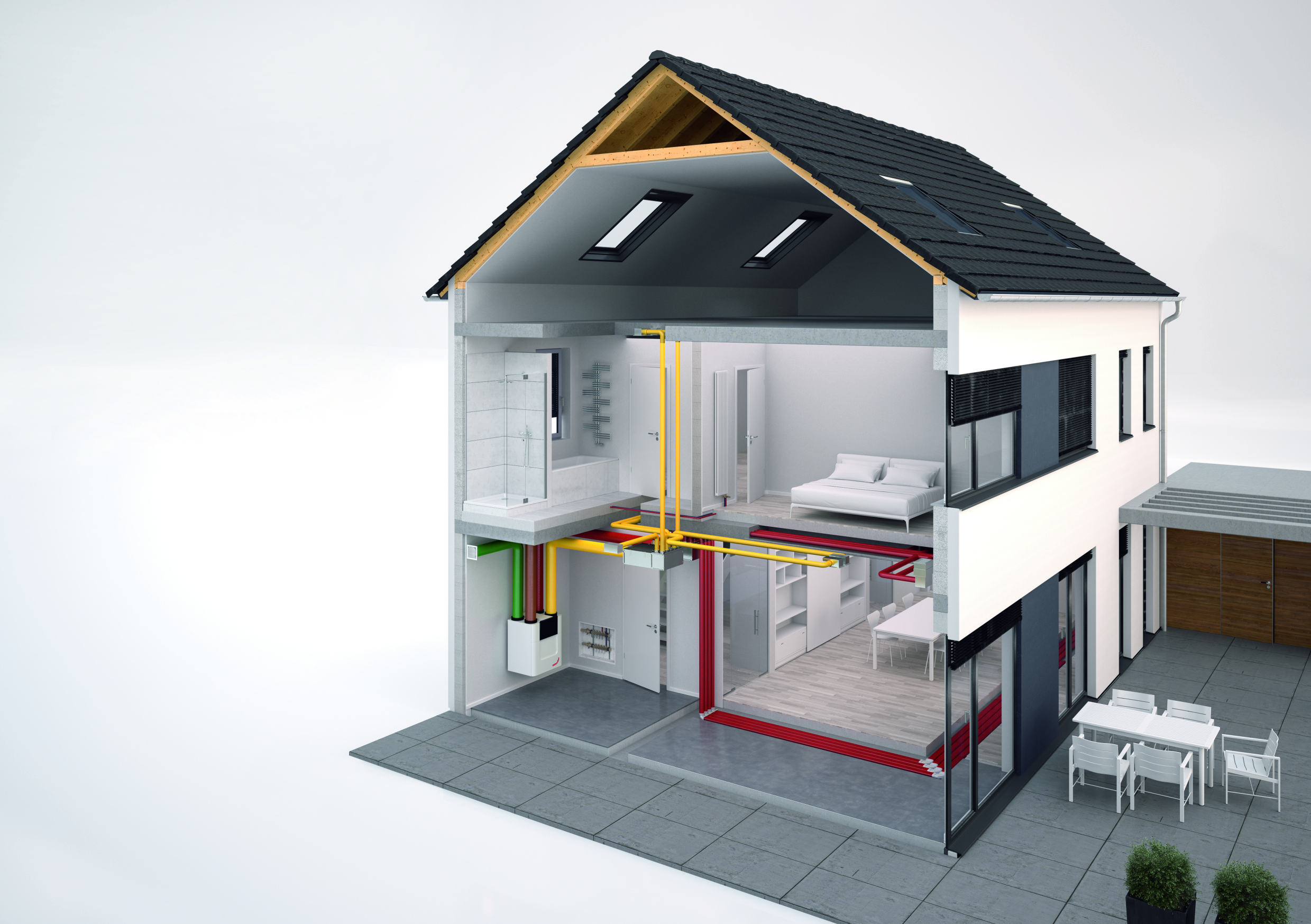
Rather than provide a precise limit at which HRV systems make sense, we believe it’s better to view ventilation options on a sliding scale. At low air tightness levels like 10 ACH, some basic continuous run bathroom exhaust fans that offer high flow and trickle ventilation may be appropriate. As you move downward from 10 ACH you might move into entry level, decentralised push-pull style HRV units. From 5 ACH downward ducted HRV systems definitely make sense and you can work your way from mid-level performance HRV units toward premium performance units for high air tightness buildings.
When should I start requesting some design support for HRV integration into my project?
Starting early once you have some floors plans to share is always good advice. This provides the opportunity to influence the building structure, so ventilation execution is simple, and avoids potential rework of structural engineering and detailing. Understandably as a builder you may be presented with fully detailed set of drawings sometimes where the client is now making a request to add a HRV system into the project. These can require extra effort but with different duct systems and installation approaches, it’s usually possible to provide a ventilation solution that works for everyone.
What’s the best approach to rangehoods to ensure adequate removal of odour and particles?
Some data collection we’ve done in conjunction with PassiveAnalytics suggests that externally discharging rangehoods do a significantly better job at removing particulate matter (PM2.5) than recirculating rangehoods. Given PM2.5 particles are a known health hazard it is prudent to use this approach.
Whilst Fantech doesn’t sell rangehoods, we’ve been approached enough times about air tightness products like dual direction duct dampers and make up air systems that we now offer solutions for some of the common challenges in high performance buildings that have higher air tightness requirements.
Our tip here is to have some early discussions with the client to determine rangehood type and flow capacity as make up air systems can be bulky and more challenging to integrate. A common trap to watch is choosing excessively high flowrate rangehoods that not only impact building comfort but also require large duct systems. Often the rush to oversized rangehoods is driven by lived experience with poorly installed rangehoods (mostly commonly with excessively long, small diameter or kinked ductwork).
Who are Fantech?
Fantech was founded in 1973 under the banner of Air & Noise Equipment, with the Fantech brand first appearing in 1982. Since then it has steadily grown to have offices in each state in Australia and the North and South Islands of New Zealand. More recently Fantech joined the Volution Group which consists of twenty plus businesses that specialise in ventilation products across the globe. Fantech supplies a wide variety of ventilation and acoustic products from simple bathroom exhaust fans through to large air handling units for commercial projects.
What are our special skills in relation to high performance buildings?
Having cut our teeth in the field of Passivhaus 10 years ago, we now have extensive experience in the concepts and design requirements that are a bit unique to high performance buildings. This extends particularly to residential buildings where we are able to offer full heat recovery ventilation (HRV) system designs, and associated ventilation solutions that become necessary in high airtightness buildings such as rangehood make up air systems.
For general ventilation support on your next project you can reach out to the Fantech office in your state. For specific HRV design support you can request this at hrv@fantech.com.au.