
One of the recurring themes from the opening day of the Australian Passivhaus Association's Thrive Conference was the challenge of making high-performance homes more affordable and accessible.
Passivhaus promotes itself as the gold standard for building performance, delivering exceptional outcomes in comfort, health and energy efficiency. Yet in Australia, it is often associated with architect-designed homes and premium budgets. While these projects demonstrate what is possible, they can also reinforce the perception that high-performance housing is only available to a select few.
That perception is one of the biggest challenges facing the movement.
A Passivhaus pioneer here in Australia, builder and Director of Carbonlite, Burkhard Hansen challenged the room to rethink how it approaches housing delivery. Drawing parallels with the automotive industry, he argued that we should stop treating every project as a one-off prototype.
Rather than customising from the outset, Hansen suggested the industry should develop a number of proven"chassis" designs and continuously improve them over time. Most residential sites are not unique, yet many, if not all, high-performance homes are effectively reinvented for every client. The result is a cycle of redesign, value engineering and compromised outcomes as projects are forced back towards budget.
The real opportunity lies in repetition. Proven designs can be measured, refined and improved. Lessons learned on one project can be applied to the next, creating better outcomes at lower cost.
The NSW Government's Housing Pattern Book initiative is a step in this direction. By providing a suite of pre-approved housing designs, the program seeks to improve housing quality and streamline delivery. However, while the designs themselves are helpful, the broader challenge remains: how do we deliver high-performance homes at scale for everyday Australians?
One of the most promising examples presented at Thrive came through a collaboration between one of our members, Maxa Design and volume builder, Metricon.
Metricon's Amira design has reportedly been built more than 5,000 times since 2016. Rather than creating an entirely new home, the team has adapted this proven design to achieve Passivhaus certification (through modelling).
Importantly, the original floorplan remains largely unchanged. Instead, the focus has been on improving the building envelope and optimising solar performance. One example is replacing the enclosed outdoor room with an open pergola that allows winter sun into the home while providing shading during summer.
But how does this stack up in terms of scalability?
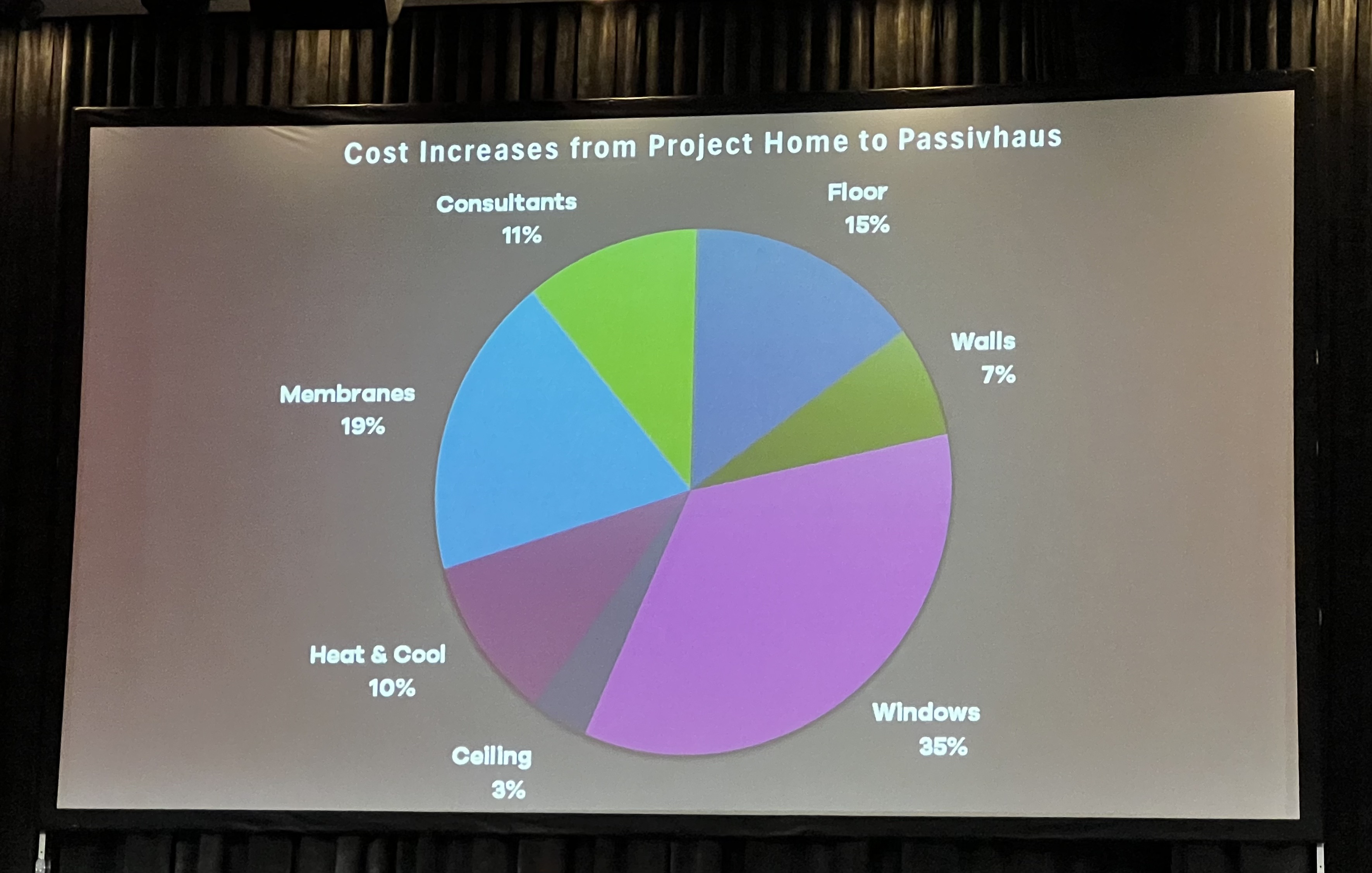
Early analysis suggests the biggest cost increases come from high-performance windows and air tightness systems. Windows remain one of the most expensive elements in achieving Passivhaus performance, while membranes and airtightness detailing add both material and labour costs.
The encouraging takeaway is that these costs are not necessarily fixed forever. As demand grows, competition increases and manufacturers begin producing products specifically for volume housing, there is every reason to expect costs to reduce.
Of course, cost is only one part of the equation.
The other challenge is delivery.
Can an industry largely optimised around speed, cost and minimum compliance consistently deliver the level of quality required to achieve Passivhaus certification?
Scaling high-performance housing will require more than better designs. It will require systems change acrossthe industry, including:
- Up-skilling trades and site teams to deliver with a quality-first mindset
- Greater competition within the high-performance product market
- Continued improvements to building regulations and standards
- Products designed specifically for volume housing and priced accordingly
- Better quality assurance throughout construction
While the Metricon project is yet to be built, it represents one of the most promising pathways we have seen in Australia for bringing Passivhaus principles into the mainstream housing market.
During the day’s discussions, another critical question was posed
Talina Edwards of Envirotecture asked should the broader housing industry be focused on moving directly from minimum compliance to the pinnacle of Passivhaus certification?
Or is there value in creating a tiered pathway that lifts performance across the entire market?
Passivhaus consistently delivers high outcomes. But sustainability is somewhat limited beyond operational energy performance.
If it takes roughly two generations of occupancy to pay off the embodied carbon associated with a typical single-family Australian home (according to the Clean Energy Finance Corporation), are we always achieving the best environmental outcome? Or should we also be asking more fundamental questions about the size and complexity of the homes we build?
This theme was explored beautifully by architect Gillian Manning through her presentation, the Story of the Kitchen.
For centuries, the hearth was the centre of domestic life. As technology evolved and homes became larger, we added formal dining rooms, formal living rooms, family rooms, butler's pantries and increasingly elaborate outdoor entertaining spaces.
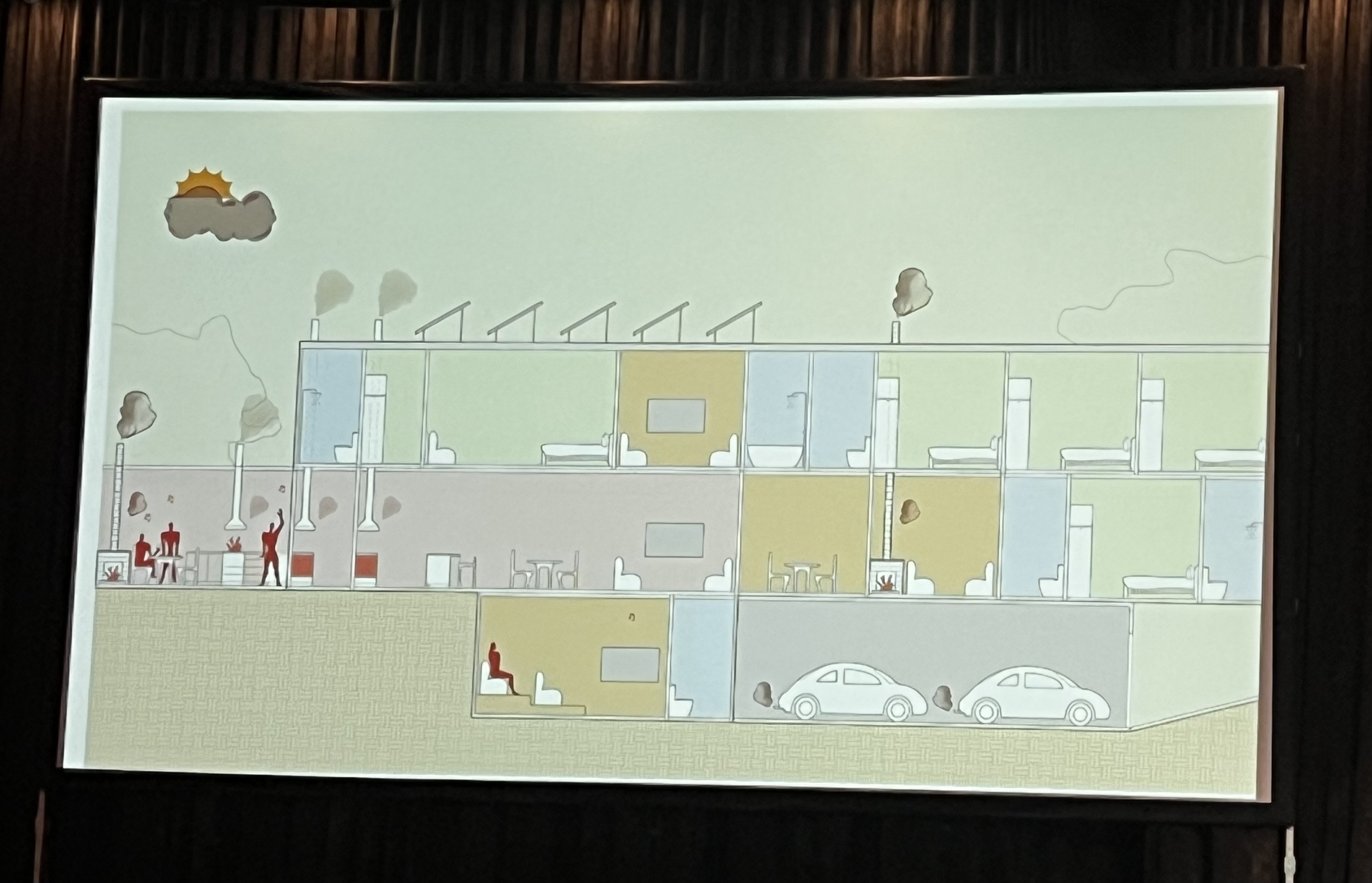
Yet despite all this additional floor area, many of our most meaningful interactions still occur around cooking, sharing food and gathering together.
Manning challenged the audience to reconsider what we really need from our homes. Rather than continually building bigger houses filled with specialised spaces, perhaps we should focus on creating homes that better support health, comfort, connection and everyday living.
Smaller homes require fewer materials, consume fewer resources and are generally more affordable to build. In that sense, reducing floor area may be one of the most powerful sustainability strategies available to us.
This is where the Sustainable Builders Alliance sees an opportunity.
We value the science, rigour and quality assurance that Passivhaus brings to the design and construction of high-performance homes. There is much the broader industry can learn from its approach.
But Passivhaus is only one part of the sustainability conversation.
Truly healthy and sustainable homes also consider passive solar design, water conservation, renewable energy, low-impact materials, embodied carbon and, importantly, building only as much home as we genuinely need.
While the industry works towards making high-performance homes more accessible, we can start improving outcomes today by understanding the broader picture. That's exactly why we developed our free Roadmap to Zero Carbon Homes, which helps building professionals and homeowners navigate the many decisions that contribute to a genuinely sustainable home.
The future of housing is not simply about building homes that perform better.
It's about the opportunity to build homes that are smaller, smarter and better suited to the lives we actually live.