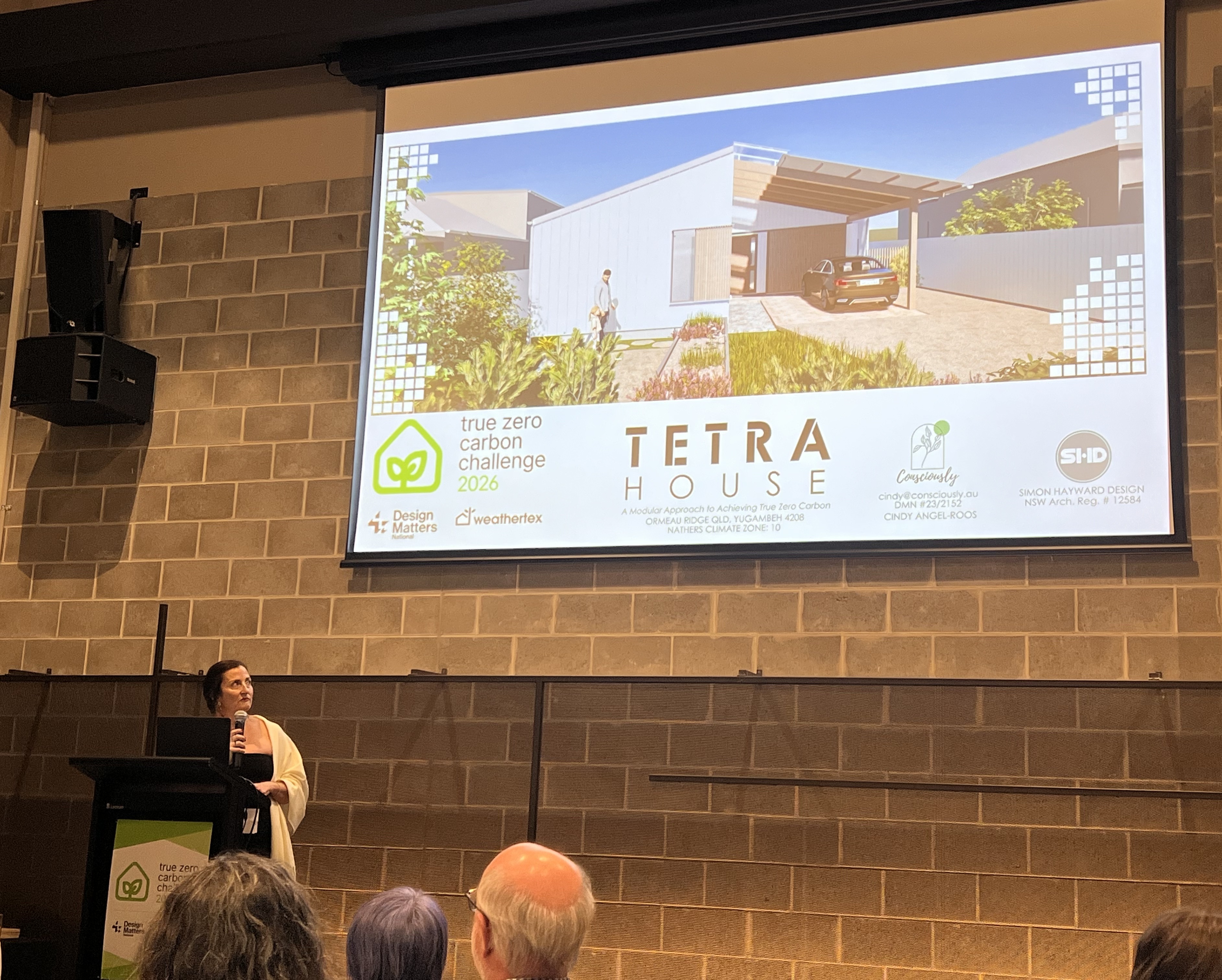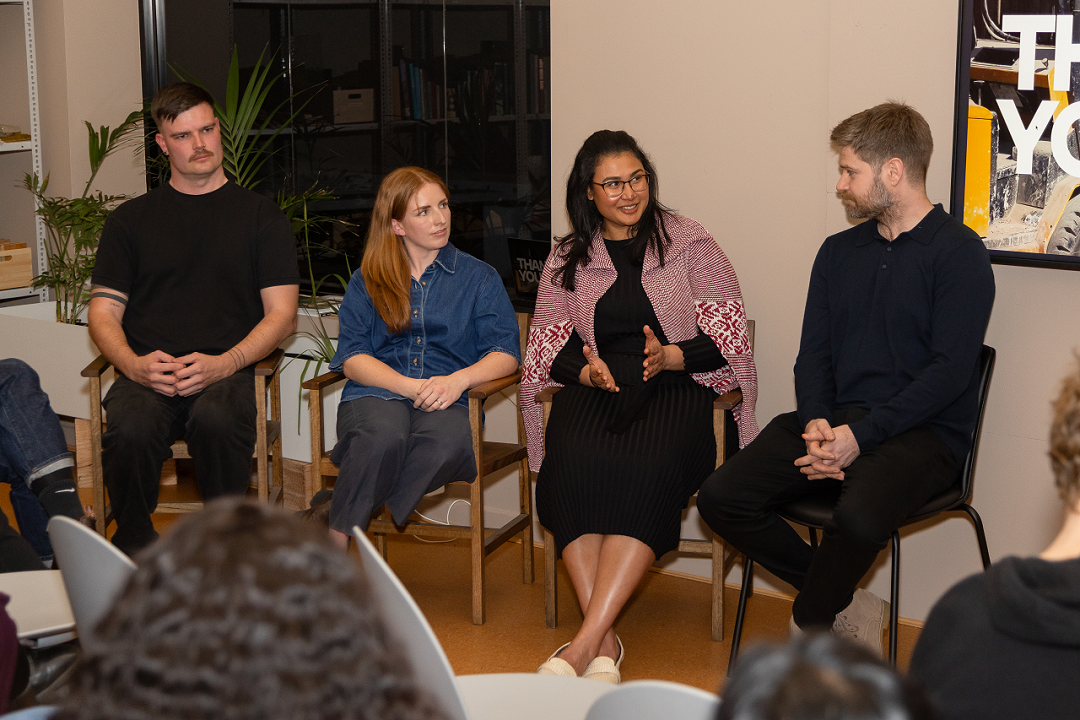

On Wednesday night, SBA members and friends packed into Breathe Architecture's Melbourne studio for Materials That Matter, an evening on practical ways to improve material outcomes and cut the impacts of construction. Thanks to Breathe for hosting and to Weathertex, our lead sponsor. MC Hamish White steered a panel of Sarah Mealy (Breathe Architecture), Steve Pettitt (HONE Built and Circlar), and Will Stewart (Natural Brick). Here's what we took away.
Material selection is small but mighty
Sarah opened with the climate context, then made the case that material selection, while just one part of a project, carries outsized responsibility. She walked through three of the six pillars of Breathe's Sustainability Action Plan:
- build less, give more - right-sized spaces, not oversized ones, and cutting material you don't need, especially in interior fit-outs, which can lift the quality of what remains
- measure - using LCAs to work with engineers on questions like how much concrete a structure really needs, and
- full circle - designing for a long first life and a viable next one, including mechanical fixings as opposed to glue so a building can eventually be disassembled.
Breathe's Guide to Sustainable Materials opens with a simple starting question: do you actually have data on your materials? Airtight modern buildings mean from a health perspective, what's inside the wall matters as much as the visible floor or benchtop. Knowing your materials well also pays off when a client wants to value-manage a spec down, and lets you provide useful feedback to smaller manufacturers scaling up before they can afford full certification and EPDs. Her closing point: don't wear carbon blinkers, health matters too.
Verify, don't just aspire
Steve's theme was certification as a discipline. Passivhaus gave HONE Built, his residential building company, a way to verify what they were building, Climate Active followed, then B Corp, each adding guardrails that free the team to focus on the work rather than reinventing the wheel. It’s one thing to say you’re doing something, but it means little unless you can verify it.
He identified waste management on site as a glaring gap in the measurement and verification of sustainability outcomes. Australia generated 29.2 million tonnes of construction and demolition waste in 2022-23, and while the reported national recovery rate is 84%, that's an aggregated industry estimate, not a verified, project-level record of what actually happened on any given job. Creating that project-level record is possible, but the process can be fragmented and labour-intensive.
That gap led him to develop Circlar, a builder-first platform for construction waste planning, evidence capture and reporting. Circlar helps builders create project-specific Waste Management Plans by identifying waste streams and matching them with suitable recovery pathways, contractors and facilities. The plan then stays live through construction, capturing what happens and the evidence to support it, ultimately creating an auditable project-level record of where waste went and what was recovered.
Backed by the City of Melbourne and RMIT’s Activator program, Circlar aims to make better waste management easier for builders while creating more credible, auditable reporting for architects, clients and other stakeholders. Longer term, project outcomes can also be fed back to architects and designers to inform better material decisions on future projects. The platform is currently moving into pilot testing…stay tuned for more.
What circular manufacturing looks like on the ground
Will's path began building homes and schools in Kenya, where everything is treated as a resource as opposed to waste - a mindset he's carried into a market where according to the ABS, from 2019-2025 knockdown rebuilds make up around 19% of our residential work.
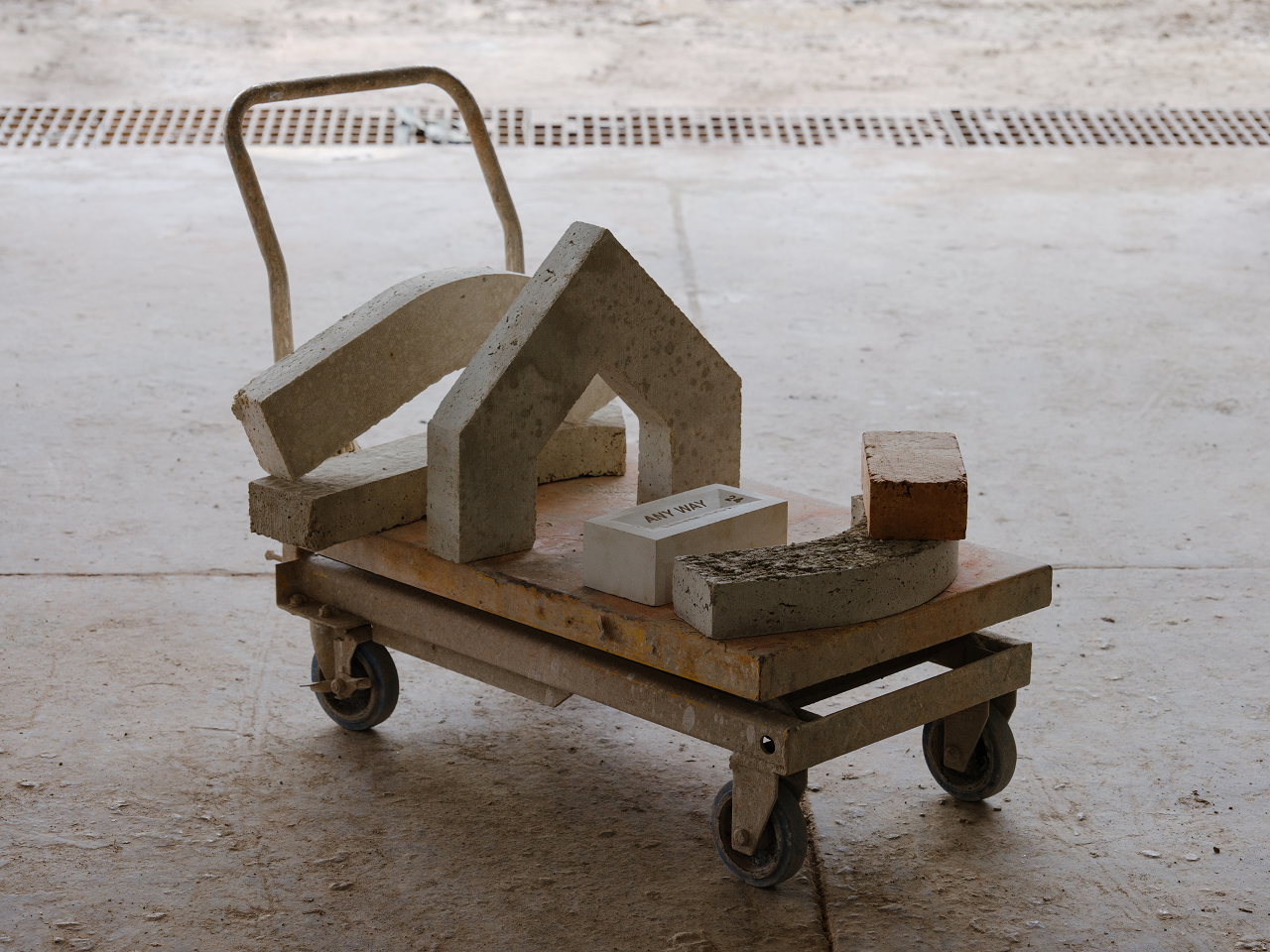
His company, Natural Brick produces handmade bricks from three ingredients: a cement and fly-ash binder, hemp, and unprocessed sand, with UV-stable pigments for colour. They’ve worked on some incredible projects from a geothermal build in the Southern Highlands to curved custom brickwork in projects in Toorak and Darling Point, made possible by reusable in-house moulds.
Before you get put off by the assumed cost of a handmade brick, Natural Brick has built its processes specifically to keep that in check. They make their own moulds in-house, and a reusable mould, good for future projects, can cost around $250. Colour is the other lever: a yellow pigment sits around $2.60 per kilo, and it's only once you move into deeper colours that price climbs meaningfully, blue is the most expensive, at around $90 per kilo.
One detail that stood out: standard Australian bricks can vary in size by up to 50mm, while Natural Brick holds tolerance to around 2mm, cutting waste and simplifying the bricklayer's job. Will's advice when budgets tighten: pick one embodied-carbon lever rather than everything at once, and solve operational carbon before zeroing in on materials. He also flagged a real constraint: Australia no longer permits the use of lime-based mortar, which has traditionally allowed old bricks to be cleaned and reused. Industry body, Think Brick is campaigning to change that, since a building not built to last a century shouldn't be laid with mortar that will outlast it.
From the Q&A
One line from the floor summed up the night: no one cares how much you know, until they know how much you care. Getting people to physically stand on a floor made from these materials wins them over faster than any spec sheet, and health and wellbeing is often a stronger hook than carbon. For architects, there was a clear takeaway for your next tender: ask builders directly what they're doing with waste, and how they're measuring circularity.
Key takeaways for your next project
- Check early whether you have data on the materials you’re specifying.
- Design for disassembly: mechanical fixings over adhesives, so materials have a next life.
- On tight budgets, tackle one lever at a time, operational carbon before embodied.
- When tendering, ask builders directly about their waste and circularity measurement.
- Treat certification as verification, not marketing.
Thanks again to everyone who joined us, and to Breathe Architecture and Weathertex for making the night possible.